AI work
I build with AI, not only advise on it. This page shows how the work is set up, how the agents are organised, and how an AI strategy review sorts where AI pays, drawn as the slides it would be presented with.
Method, drawn from systems I built and run for my own practice. The slides are simplified illustrations, not client work. The last band draws on in-house work at PIMCO.
01 · Method, own practice, 2026
Context before the model
The situation
An AI tool with no context starts every task from zero. It forgets decisions, repeats mistakes, and produces work nobody can trace back to a source.
What I did
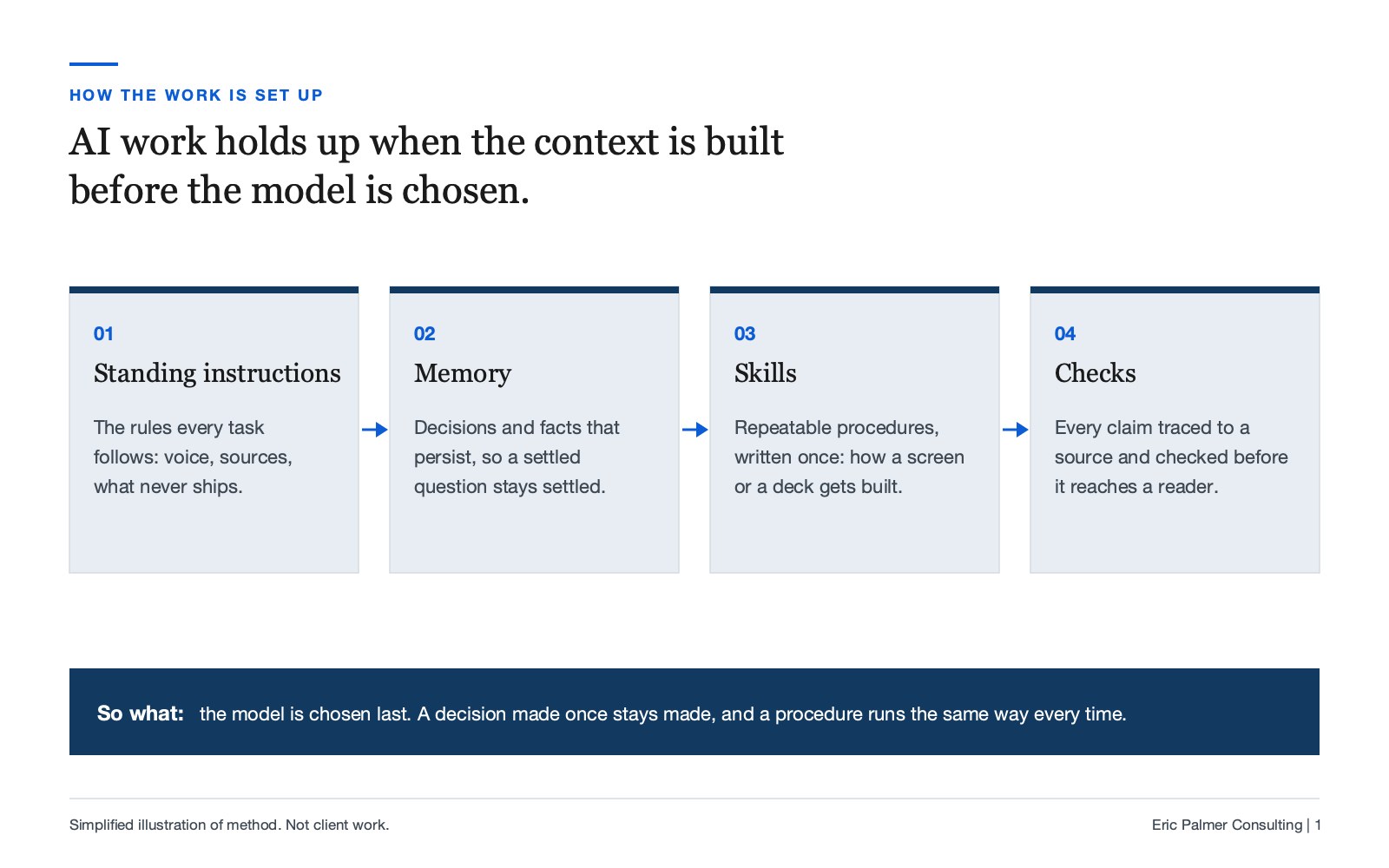
Before choosing a model, I set the work up in layers. Standing instructions every task follows, a memory of settled decisions, written skills for each repeatable task, and checks that trace every claim to a source.
What came of it
The same setup runs a research system I architected and built, which orchestrates 25+ AI agents across 60+ data sources every day.
02 · Method, own practice, 2026
Agents with one job each, and a review before the decision
The situation
One assistant asked to research, analyse and write in a single pass blends the three, and when the answer is weak nobody can see which step failed.
What I did
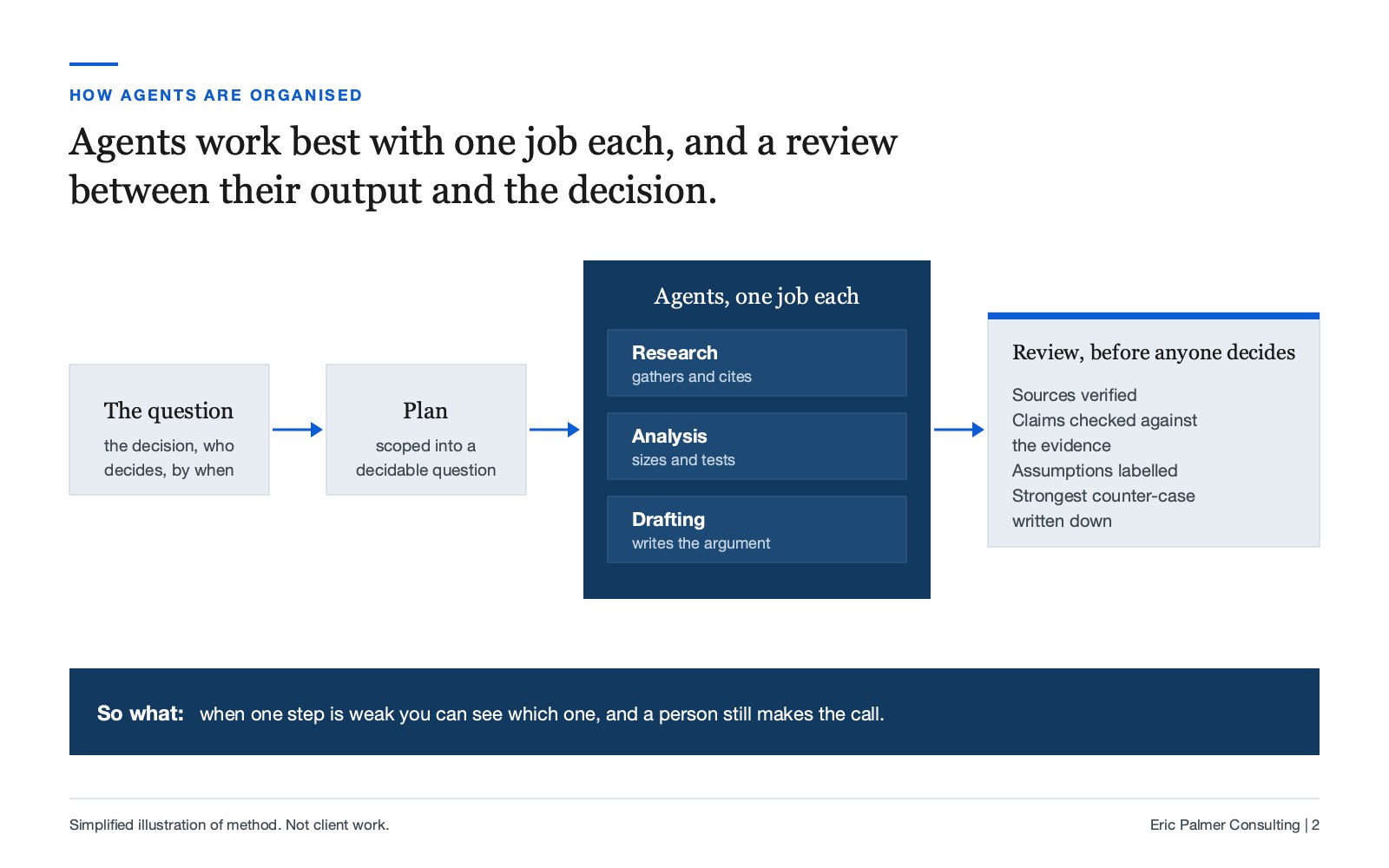
I split the work into agents with one job each, for research, analysis and drafting, run against a question scoped first. Then a review sits between their output and anyone's decision. Sources verified, claims checked, assumptions labelled, and the strongest counter-case written down.
What came of it
A recommendation that carries its assumptions and the strongest counter-case, for a C-suite or board to act on.
03 · Offer, own practice, 2026
An AI strategy review that sorts where AI pays
The situation
Inside a large company the AI question is rarely whether it works. It is where it pays, what has to be true first, and what it costs to keep running.
What I did
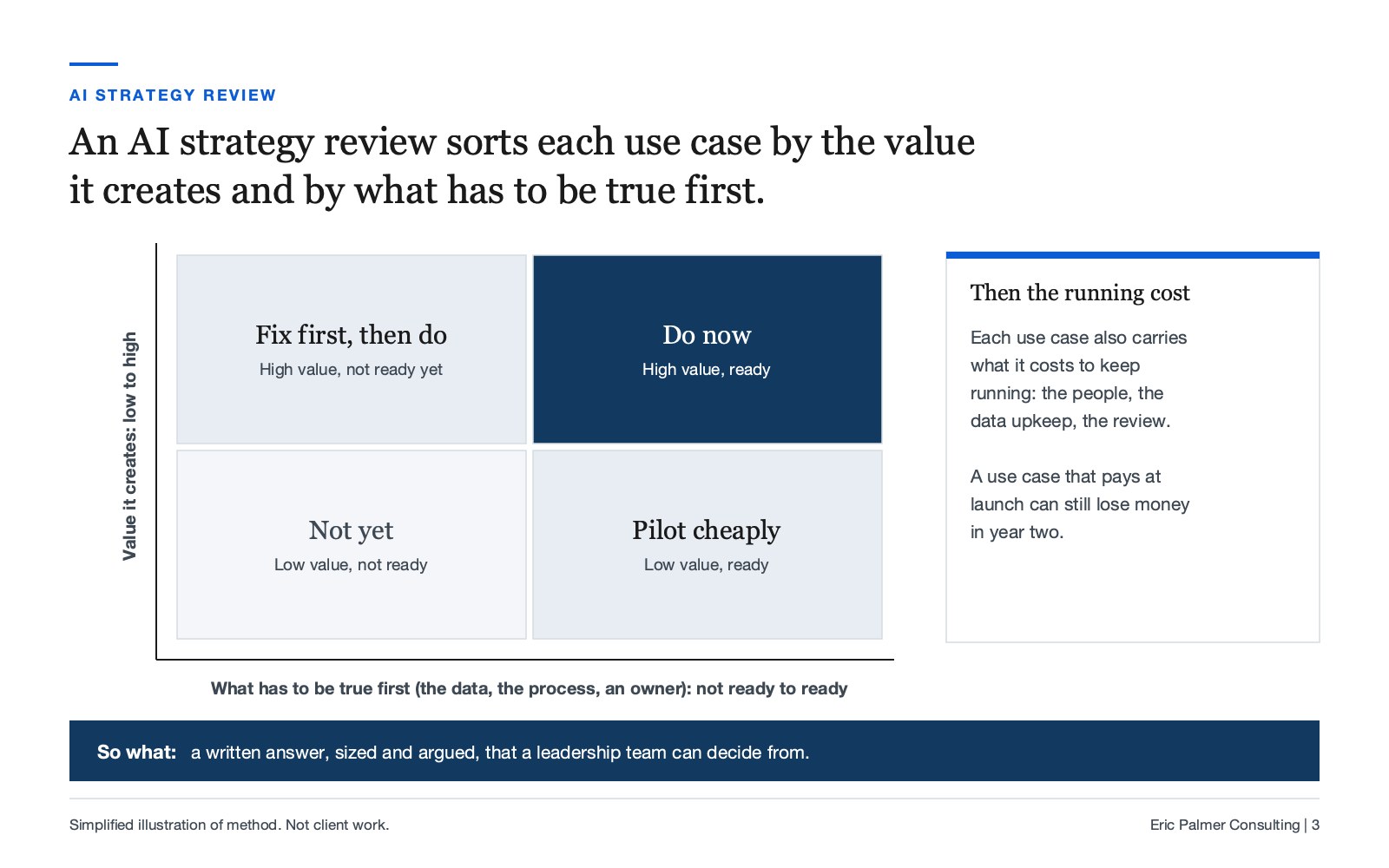
The review sizes each use case by the value it creates and by what has to be true first, the data, the process and an owner, then adds what it costs to run. Each one lands in one of four groups. Do now, fix first, pilot cheaply, or not yet.
What came of it
A written answer, sized and argued, that a leadership team can decide from and argue with.
AI set up for your team
Most teams have AI tools and no setup around them. That is the part I do. The standing rules every task follows, a memory of decisions already made, written steps for the work your team repeats, and checks that trace each claim to a source.
It runs on your own accounts, with each tool given only the access its task needs. The usual shape is one engagement. The setup, a working session with your team, and a written guide so it keeps running after I step away.
The habit is older than the tools. At PIMCO I led a cross-functional team that built an internal application giving real-time access to client account balances and transactions, which turned quarterly reporting into something people could check any time.
For more information, send a short note on what your team does today and where AI is helping or not.
Related
How engagements work →AI use-case review →Fixed-scope work →